

What can we do when adjusting the circular beam of round led light for square illumination
09-05-2026
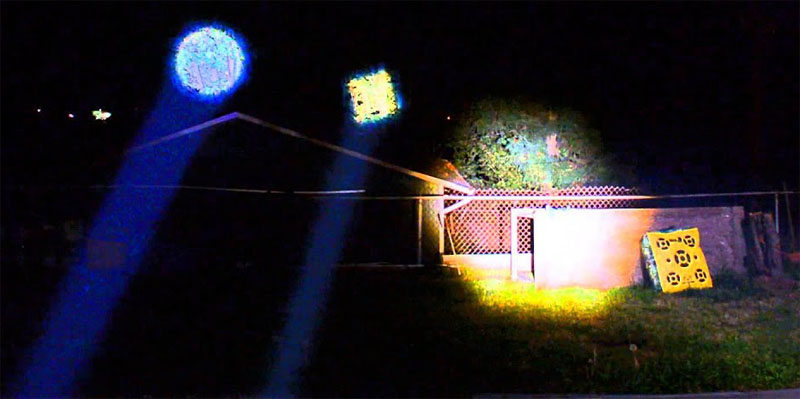
You can replace a standard round reflector or lens with a custom-molded TIR lens designed with a square output face. These lenses use precise internal geometry to redistribute the circular light from the LED chip into a defined 1:1 square ratio. Also, micro-lens arrays is another solution, which are thin sheets or lens covered in thousands of tiny hexagonal or square "micro-lenses" that breakup and reshape the beam into a square type with very high uniformity.
If you cannot change something in the internal optic structure, you can apply a Light Shaping Filter (LSF) or a Holographic Diffuser over the front glass.
These light shaping filters have microscopic surface structures that scatter light in specific directions. So the beam can be specifically spreaded into a square or rectangular distribution. This is a easy and simple solution, but it often results in a softer edge compared with a internal optical lens.
In stead of internal shutters, we can attach external barn doors to the exterior aluminum housings to manually cut off the edges of the circular beam. This is highly flexible but imperfect solution that can create a "hard" shadow edge and wastes some of the light output that is blocked by the flaps.
The cheapest and simplest method is to use a mask. You just place a heat-resistant plate with a square cutout directly in front of the LED work lamp or within the focal plane of the lens.
This is called "subtractive" shaping. That is to say, you are blocking the corners of the circular beam to make a square, you will lose about 40% percentage of your total lumen output.
For 7 or 9 inch high-power led work lights, the internal reflector can be faceted. Instead of a smooth, cone-shaped polished optics, the reflector is built with segmented flat facets arranged in a square configuration. Each facet is angled to aim light toward a specific corner or side of the target area, then it effectively folds the circular beam into a square footprint.
©Copyright: 2008-2026 Guangzhou TEEHON Electronics Co., LTD. 